My commute from Salem to Boston and back again is very soothing and whimsical—commuter rail and sometimes the ferry. Here is a collection of some of my favorite commutes, in various seasons and weather situations.
(I fully do not expect you to watch a six-minute video of a train ride; definitely you should skim.)
Commuter rail
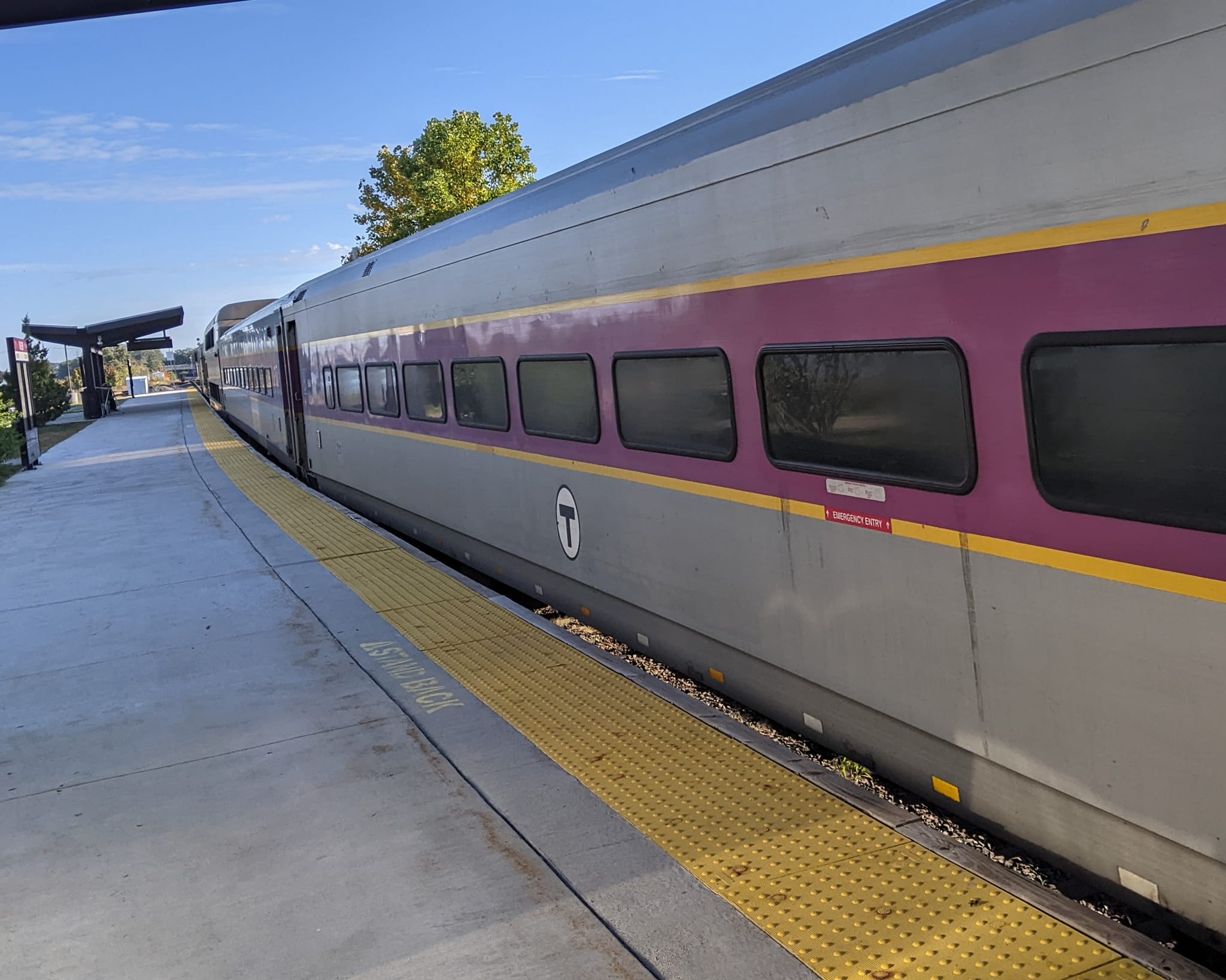
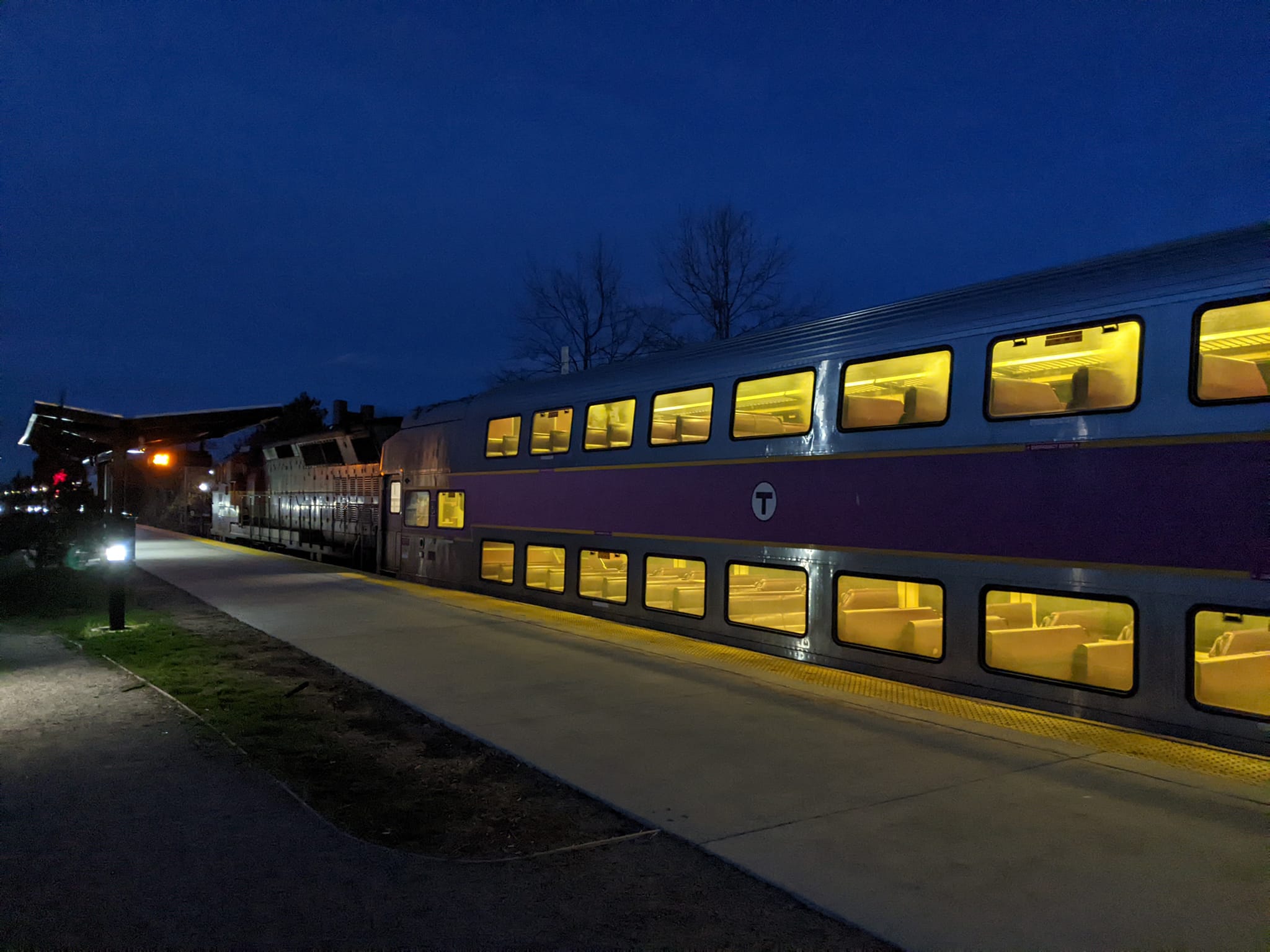
Usually (almost always) I take the commuter rail to get to work. Here is the commuter rail itself, in daytime and at night.
Salem station in the snow
This was my recent commute view the past weeks—Salem station in the snow.
Snowy train ride from Salem
This is the train ride accompanying those views. Possibly the coziest I have ever felt on a train.
Salem station in the fall
Here is Salem station in autumn.
Foggy train ride to Salem
This was a remarkable trip, with fog the whole way.
Birds and docks
I love the parts where we pass over the water. And sometimes I get to see birds.
From Salem to Boston by boat in the summer
When I’m lucky I get to work by boat. The commuter ferry leaves very early in the morning (7am), so I rarely make it, but when I do make it it’s always very exciting to get to be on a boat—and casually, as my commute. Here is the ferry ride from Salem to Boston in the summer.
Boston in the fog
Here is Boston in the fog, from the Boston (red line) side of my commute.
Boston in the fall
Here is Boston during sunset in autumn, viewed from the red line.
Me on the train
Here is me on the commuter rail, in November 2021. I still wear my mask for my commute. (If I get covid, it’s not going to be on the commuter rail or the red line or the green line or the orange line—and no one being able to read my facial expressions is a nice bonus.)
I first knew it was October when we were walking down Essex Street to go to the farmer’s market and a guy dressed as something spooky from a movie I hadn’t seen switched faster than I think I know how to from completely statue-still to reaching his hand out at me. (I screamed and he felt so bad but it was perfect.)
Living in or near Salem for Halloween is bizarre. My train commute gets absurdly crowded. You can’t park in town. You can’t drive through town. Random people start parking and sometimes sleeping in their cars on our street. Crowds are everyone. In October, we actually go downtown less.
We and all our neighbors are getting dressed up, and we and all our neighbors are hyped for trick-or-treaters. We of course absolutely do all the tourist things. We go to the awesome weird Halloween museums. We go to the awesome weird Halloween shops. I think everyone in Salem loves Halloween. Someone asked my friend who works in a spooky shop what happens to Salem the rest of the year, as if we all go sleep or hide somewhere. Everything stays more or less the same. Someone in our neighborhood has a giant skeleton in their yard, about a story tall, which we think they must have bought without considering where they would store it. The skeleton stays out year-round; for holidays, it gets dressed up in relevant outfits but it’s still a skeleton. Salem is like that. We still love the spooky shops, year-round. We still go to the spooky museums, year-round. Graveyards are peaceful in all seasons. The spooky arts festivals are in the summer, too. I don’t think anyone could stand it here if they didn’t like Halloween—or pumpkins or spiders or witches or bats or black cats or spiderwebs or graveyards or Tarot readings or incense or pretty and expensive rocks.
Everyone decorates for Halloween, but the truth is, for the most part, Salem decorates itself.
The gorgeous foliage? That’s just how it is here. The graveyards and cemeteries everywhere? That’s just how it is here.
The pumpkins growing in the front yard? We didn’t plant them. The spiderwebs outside our house? We didn’t plant them either. That guy dressed up as a clown? He’s an actual clown; it’s not his fault you’re terrified of him.
Speaking of pumpkins we didn’t plant—here are the pumpkins we didn’t plant. They appeared over the summer and took over the front of the house. We had to trim them to keep them off the flowers our housemate had actually planned and planted. They grew gorgeously twined around our spooky little library. We think a pumpkin must have fallen off the porch last year and planted itself. We don’t know where they came from.
Importantly, bees sleep in the pumpkin flowers.
And later, at harvest time. See if you can guess which pumpkins aren’t real pumpkins.
It’s not just us—here’s a gourd I found growing in front of a neighbor’s house.
And here are the pumpkins we did plant.
They are all either already soup or going to be soup.
I planted radishes with them and the radishes also grew happily; here are the radishes.
And here is fall foliage in the cemetery.
Here are Halloween decorations in our neighborhood at night, on my walk home from the commuter rail.
Ten of the 14 counties of Massachusetts are currently in a Level 3 drought, Critical Drought—including Suffolk County, which contains Boston; Middlesex County, which contains Cambridge and Somerville; and Essex County, which contains Salem. This is a ban on all non-essential outdoor water use (not including our vegetable garden).
This past month watering has sometimes felt kind of futile. I’d water and then less than an hour water the soil would be dry like I hadn’t watered at all, or our housemate PJ would water and I’d come outside and think she hadn’t watered because the soil was already dry.
Given that we are in a drought, and that I’m not really sure what Level 4 is going to look like, I got curious about how much water my various daily water-using activities take up.
Normal Shower
On Sunday I took a shower like I normally do, except this time with the drain plugged, with the water on while I:
apply shampoo
rinse off shampoo
apply conditioner
soap legs and shave
rinse off
brush my teeth
rinse off conditioner
soap everything
rinse off
This shower took 16 minutes and 20 seconds.
At the end of the shower the tub was full to 13.7 cm depth in the middle or 13.4 cm depth one-third of the tub in from each side. I’m going to assume the average depth was about 13.4 cm. The sides of the tub are sloped, but halfway up the depth of the water, at 6.7 cm depth, the tub is 50.8 cm wide and 124.5 cm long. The volume of water, then, was 13.4 cm × 50.8 cm × 124.5 cm = 84,700 cm³, or 22.4 gallons.
(I also timed how long it takes our shower to fill two cups. It took 6 seconds to fill 2 cups, or 48 seconds to fill a gallon, which means 16 minutes and 20 seconds used 20.4 gallons of water. I’d say the two estimates are close enough.)
Water-Saving Shower
On Monday I took a water-saving version of my usual shower, which went like this:
turn on shower, get moist, and turn off shower
apply shampoo
turn on shower, rinse off shampoo, and turn off shower
apply conditioner
soap legs and shave
brush my teeth
turn on shower, rinse off conditioner, and turn off shower
soap everything
turn on shower, rinse off, and turn off shower
Still the same number of steps, just colder and creepily quiet.
This shower took 12 minutes and 36 seconds total, including both water-off times and water-on times. At the end of it the tub was full to 5.4 cm depth in the middle or 5.1 cm depth one-third of the tub in from each side. Halfway up the depth of the water, at 2.6 cm depth, the tub is 48.3 cm wide and 120.7 cm long. The volume of water, then, was 5.1 cm × 48.3 cm × 120.7 cm = 29,700 cm³, or 7.9 gallons.
Only having the water on to rinse off, in other words, uses 35.3% of the water used by my normal shower.
Bath
I started taking baths only recently, when a collaborator and friend said they’d started taking baths during the pandemic to disconnect from the world and I decided I wanted to try it. I take a bath once or twice a month, especially in challenging months, though sometimes I miss months, presumably because they aren’t challenging months. Highly recommend, especially with a nice book.
When I take a bath I fill the tub up most of the way—about 25.0 cm depth. Halfway up the depth of the water, at 12.5 cm depth, the tub is 52.1 cm wide and 127.0 cm long. The volume of water, then, is 25.0 cm × 52.1 cm × 127.0 cm = 165,400 cm³, or 43.7 gallons.
Taking a bath, in other words, uses about twice the water used by my normal shower, or about 5.5 times as much water as a water-saving version of my normal shower.
Watering the Vegetable Garden
Next I measured how much water I use when watering our vegetable garden. I timed that it takes on average 2.384 seconds (average of five samples: 2.38, 2.60, 2.50, 2.26, and 2.18) to fill two cups—or 19.1 seconds to fill a gallon—using our water hose at the setting I use, coincidentally called the shower setting. I then timed myself watering the plants, pausing the timer whenever I paused the plant-watering. It took me five minutes and 26 seconds to water the plants, or 17.1 gallons.
Back when we lived in Cambridge we had a tiny countertop dishwasher (referral link, which means I make a small amount of money if you click and buy something) I ran once a day for the two of us. At some point our kitchen sink wasn’t draining so I unhooked the output house and left it in our tiny under-sink recycling bin. A full dishwasher run filled at most a fourth of the tiny four-or-five-gallon under-sink recycling bin with dirty water, or at most 1.3 gallons.
Handwashing dishes, at least the way I do it, uses substantially more water than a dishwasher. I used to pre-rinse dishes before loading them into the dishwasher and that was dumb and I didn’t realize it was dumb until my parents pointed out to me that it was dumb. Modern dishwashers have gotten good enough that they wash the dishes quite well on their own, and even if they don’t it’s still better to just wash any still-dirty dishes with the next load. Some modern dishwashers apparently even have a garbage disposal.
Washing the Laundry
I run our high-efficiency front-load washing machine on normal or, usually, normal with extra rinse. I couldn’t find actual water usage online and wasn’t willing to spend much time looking but it looks like a similar washing machine uses 11.9-13.9 gallons. I think I run the laundry machine on average 1.5 times a week, so that averages out to 2.6-3.0 gallons a day.
Flushing the Toilet
Our toilets are water-saving toilets with two flush modes, one that uses 1.6 gallons and one that uses 1.1 gallons.
Apparently older toilets from the 1980s through 1992 used 3.5 gallons per flush, and earlier toilets used 5.0-8.0 or more gallons per flush. The average American apparently flushes the toilet five times a day, so the difference between an old toilet and a new toilet adds up.
Washing My Hands
I timed myself washing my hands: 16 seconds. Running the sink for eight seconds filled two cups of water, so washing my hands uses four cups of water, or one-fourth of a gallon.
taking a water-saving shower: 7.9 gallons/person/day
taking a normal shower: 22.4 gallons/person/day
taking a bath: 43.7 gallons/person/day
Going to the bathroom:
flushing a water-saving toilet: 1.1-1.6 gallons, or maybe 5.5-8.0 gallons/person/day
flushing a 1980s-1992 toilet: 3.5 gallons, or maybe 17.5 gallons/person/day
flushing a really old toilet: 5.0-8.0+ gallons, or maybe 25.0-40.0+ gallons/person/day
washing my hands: 0.3 gallons, or maybe 1.5 gallons/person/day
Dishes and clothes:
running the dishwasher: 2.4-6.8 gallons, or 0.8-2.3 gallons/person/day
running the laundry machine: 11.9-13.9 gallons, or 1.3-1.5 gallons/person/day
Sustaining life:
drinking: 0.7-1 gallons/person/day
watering the vegetable garden: 17.1 gallons, or 5.7 gallons/person/day
My personal total daily water usage ends up at 42.4 gallons per day, 22.4 of those gallons being my showers:
I am needless to say absolutely horrified by my water usage. I’m surprised by just how much water my daily showers use relative to the rest of my water-using activities, and how much a small (to me) change to my shower habits improves my overall water usage—me switching to water-saving showers should save about 5,300 gallons a year, which is enough to fill a 15-foot-diameter backyard swimming pool. I’m also stunned by how much water our water-saving toilets save. The dishwasher and laundry machine use more water than I expected, but when that water is divided by the number of people and frequency of use they use less water than I expected. Once the water use from showering is decreased, watering vegetables and flushing the toilet become close contenders, which also surprises me—but that means those are the areas to focus further improvement.
PJ and Cory set up a giant 55- or 60-gallon rain barrel that collects the water that runs down the gutters from the roof. The rain barrel has so far vacillated between no use for weeks to overflowing in a few days, because that is about what the weather is. We also collect about two gallons of water a day from the basement dehumidifier. Both of these sources we use to water plants, so they offset our water usage a little bit.
Some easy ways I am going to try to use less water without altering my lifestyle:
I’m very happy with the water-saving version of my shower, especially now that I am also occasionally taking baths and I should offset the baths somehow. The water-saving version allows for less standing around in the flowing water, but I listen to music (this is my shower speaker—referral link so if you click and buy I get a small percentage) while I shower anyway so maybe that’s okay. When it’s not so hot I sometimes switch from daily shampoo and conditioner to shampoo and conditioner once every two days, so that will also help. I also have been considering trying sugar waxing instead of shaving to save shower time (not actually for the water but because I’m lazy), so that will also help a little.
It should also be very easy to decrease water usage from hand washing just by running the water less intensely; I could probably use half the water without noticing much difference.
Right now I am the kind of person who wears clothes once and then washes them even if they are still clean. I am going to start wearing pants and skirts at least twice before declaring that they are dirty. I’m also going to buy more of our rate-limiting clothes, which is bras for me and work shirts for Cory, so that we can stretch the time between laundry-doings a tiny bit. Not just water saving—again, I am lazy.
Kind of tempted to not flush pee when I’m working from home alone. Kind of. We’ll see how committed I end up being to this endeavor.
Our housemate/friend/landlady PJ is thinking about getting a second rain barrel, which will shift more of our vegetable garden watering to rainwater (when we get rainwater).
We are also thinking about switching our vegetable garden watering to drip irrigation, which should use less water—but that’s a lot of work and who knows if we’ll get to it.
Luckily the biggest changes are not hard to make. I’m glad I measured.
A few weekends ago we went to North Shore Pride! It was my first time at any kind of Pride event. I am extremely uncomfortable in crowds, but given recent events it was important to me that I show up. It was absolutely lovely. Everyone was so happy and lovely and kind and welcoming and happy and kind. I dressed up as a bisexual mermaid pirate and to my absolute delight Pride turned out to be in part a car show. I know cars aren’t exactly the point of Pride, but it was an unusually good day for cars, even for the North Shore. I am very excited to show you the cars.
My earrings are by Night Owl Jewelry, purchased at the Girl Gang Craft Fair in Salem. My necklaces are all gifts from my maternal grandmother. Car identifications and fun facts are by my dad and my brother, who know an extraordinary lot about cars (and are usually the sole recipients of my streetside car photos).
Here’s me:
Here’s cars:
2016 Mazda MX-5 Miata
We met this Miata in the garage on our way to Pride, parked near us.
1957 Chevrolet Bel Air
The most interesting car of all turned out to be one we saw on the walk to Pride, not at Pride itself. This is a 1957 Chevrolet Bel Air.
This Bel Air, in part because of the black paint and all the chrome, looks a lot like a shorter GAZ Chaika 13, to the point that we initially thought it was a GAZ Chaika 13. The GAZ Chaika 13 is a very interesting car. It was used by the government in Eastern Europe in the 60s through 80s. You can read more about it here.
The GAZ Chaika 13 was also rented out for weddings, a lot like the limo in the United States. My parents rented one for their wedding. They said it was a bit rattly.
(Since my initial googling of all these cars I’ve started getting ads for them, especially for 1957 Bel Airs. I of course do not mind.)
The following cars were part of the Pride parade itself. The very best cars were the very first part of the parade and then interspersed throughout.
Ford Gran Torino
???
We couldn’t figure out what this car is.
1970s (1972?) Oldsmobile 442
1960s or 1970s Dodge Charger
1975 Cadillac Eldorado
2015 Ford Mustang
Volkswagen Beetle
2015 Chevrolet Camaro
2014 Rubicon Jeep Wrangler in rainbow, possibly sponsored by Skittles (?), which makes sense
Finally, another of the most interesting cars we saw that day was again not in the parade itself; this one was on our way home.
1984-ish Cadillac Coupe DeVille
The Coupe DeVille is a very special car. It’s had a large cultural impact and appears in a lot of songs. Here are some of them:
1964 Ford Mustang
And the final car of the afternoon, seen from a distance.
This 4th of July we spent the day at the Marblehead Festival of Cod, as well as the rest of the also very excellent but admittedly less cod-related Marblehead Festival of Arts. In the Festival of Cod, regional artists decorate wooden codfishes, the decorated codfishes are displayed in storefront windows in Marblehead, whoever wants to bids on the codfishes in an auction online, and the money from the auction goes to future Marblehead Festival of Arts programs and scholarships.
We approached the experience like an unguided scavenger hunt—we ambled around more or less downtown in Marblehead and ran up to look into storefronts when we saw cods in the windows. We got to see a few lovely ocean-focused art galleries and of course the arts festival itself, where we bought a few really lovely ocean-themed wood pieces I continue to feel guiltily and happily covetous of. The cod auction was less pricey than I expected; next year maybe I will bid on a few.
Here are the cods we found, in their natural storefront habitats.
“Marblehead Regatta” by Paula Cardarelli, oil on wood:
“Garden Cod” by Katie Appleton, mixed media collage:
“Sunset Sail” by Elaine Caliri Daly, acrylic:
“Fish Form Meets Function” by Kim Leventhal, paper:
“Beta Virginus, the Second Brightest Star” by Eleanor Fisher, glass shard objet d’art:
“Ms. Cod” by Dayle Persons, altered art, decoupage, mixed media:
“Joyful Journey” by Monica Benton, decoupage with Giclee archival printed material, gold paint, jeweled eye:
“This Cod Came to Party” by Kent Stetson, digital paint, vinyl, crystal—which I was delighted to see had a matching dress next to it in the shop window:
“Caribbean Cod” by Lisa Durkee, epoxy resin with metallic pigment and beach sand:
“Banks Cod” by Bill Frost, pine:
“Abstract Gadus morhua in motion” by Jess Russell, encaustic wax, mineral-based pigment, pan pastels, and shellac on pine:
“Waterfront View 2022” by Marua O’Connor, acrylic ink:
“Old Marblehead” by Polly Maxon Tritschler, acrylic:
“Mouth of Marblehead Marsh” by Jodi Shea, oil on wood:
“There is a Cod Out There” by Ruth Rooks, watercolor/gouache (protected with acrylic spray):
“Little Harbor Cod” by Ellie Tomlinson, acrylic paint on wood:
“Dottie” by Mary Taddie, mixed media:
“Bluefin Red Boat” by Tracy Finn, acrylic on wood:
“Bubbles Below” by Ellen Garvey, blown and fused glass:
“Once Upon a Time in Marblehead” by Siobhan McDonald, acrylic paint:
“Bones” by Susan J. Schrader, wood, acrylic, nail, silver thread, aluminum:
“Striped Sea Bass” by Kirsten Bassion, stoneware:
There were tons more cods we didn’t find. You can view them all (with much higher quality photos than mine and with information about the artists and the storefronts) at the auction site:
When we got home that evening the whole country put on a show, probably for Marblehead’s Festival of Cod but maybe also for another holiday. Here are this summer’s 4th of July fireworks viewed from our home in Peabody/Salem, in the direction of Peabody and Danvers and the sunset.
That sunset:
Years ago, on the 4th of July, rather than go to a single fireworks show my family went driving in Pennsylvania, hills and valleys and hills and valleys, passing town after town, and at all times we were surrounded by fireworks, not one show but many, all at once and all around us. It was my favorite 4th of July. This 4th of July felt like that. Ocean air, not cold Pennsylvania air, and the window of a house, rather than a car driving and the wind on us, and different people I love around me—but like that.
When they started out, Peabody, Danvers, and Salem all started out as a part of Salem. Salem Village, which is what you think of when you think of Salem (and where the witch trials happened) is in the current-day Danvers, wedged in an unassuming residential neighborhood. Danvers State Hospital, or Arkham Asylum, is of course also in Danvers, and on my partner Cory’s drive to work every day. History. The North Shore has history.
Cod Fest was our first time in Marblehead. Marblehead is all ocean and hills and rocks and remarkably (for America) old (older than America) buildings. I started out photographing every building with a plaque, but I very quickly stopped being impressed by anything from the mid-1700s onwards (and was starting to be a danger to myself and drivers in very fancy cars trying to navigate roads that weren’t built for any kinds of cars). The North Shore has wonderfully many houses that are older than America and in which people continue to live.
Here are some houses we saw in Marblehead from the early 1700s and earlier, including three houses from the 1600s. The earliest we saw on this walk was 1636:
Here’s what the world around these houses looks like:
We made our own little library! Our little library is not only an accomplishment of a yearslong fantasy, it is also a constant source of joy when people stop by and a great excuse to buy books. I did most of the planning and designing, with construction and style guidance from my parents and my partner Cory and our friend and housemate and generous feudal lady PJ, and fixing from Cory, an actual mechanical engineer, when things broke. I think PJ wanted to buy a professionally built little library, at least at first, but I wanted to do something ill-advised, amateurish, in retrospect possibly manic, and from the soul and also to use a dremel for the first time in ten years.
Our little library is painted black and the books have a sometimes spooky tint, because we live in a not-yet-painted-black house that may or may not have its own soul (and if it does have its own soul, or a visiting soul (other than our visiting souls, of course), it is absolutely a spooky one) across the street from a graveyard in Salem—which of course means that most of our neighbors and subsequently most of the visitors to our little library have died. Spooky books are often also joyful books, and hopeful books—but sometimes just spooky.
This is a blog post about how we made the library/libraries. Spoiler alert, it ends up looking like this:
This blog post includes links with my Amazon referral code. As an Amazon Associate I earn from qualifying purchases. If you click a link and buy something, I get about 4% of the price as commission. You don’t have to buy these things from Amazon—actually, you don’t have to buy these things at all. You can also support me by buying merch of my art, by buying me a campground store decaf coffee, or by simply reading and enjoying. Thank you!
Ingredients
Here’s everything I bought to make the library:
A reasonably-sized waterproof bathroom cabinet, to serve as the larger library—we painted it black, but this one was originally white, which already looked very nice as a potential library
A narrow waterproof bathroom cabinet, to serve as the small library—this one is dark brown, since it was closest to the intended black, but it also comes in white
Black outdoor paint, to paint the cabinets our preferred color, which was black—but you can choose a different color, or you can choose to not paint your libraries at all
Barrels to plant your libraries in—I bought these fancy wooden bucket barrels (18 inch, 15 inch, and 11.5 inch diameter, one for each library and the smallest destined for flowers). I like them a lot because the real wood and its smell and its texture and the metal handles were important to me because smells and textures are important to me in general, but they are expensive; cheaper, perfectly acceptable, possibly more durable plastic bucket barrels exist, and different sizes and shapes and quantities of the wooden ones—this is the fun part; you could even get this weird wishing well planter I’ve been trying to find some excuse to buy (but I have nothing in particular I want to do with it and nowhere in particular I want to put it) and stick a library in it, which is what I would probably try to do if we decided to add a third library
And here are things we already had that we also used:
A dremel, to cut out interestingly shaped window-holes
A sturdy pocketknife, to cut the plexiglass to fit the window-holes
Variously sized small pieces of scrapwood, to attach the roofs to and to make lock-type turning mechanisms so the doors don’t blow away
A drill and drill bits and screws, to attach the roofs so they don’t blow away and to attach the lock-type turning mechanisms
Lots and lots of rocks
Dirt
Flowers
A very strong glue to fix things when they break, like JB-Weld or Gorilla glue
And some things I bought to put in the library once we built it:
First, I assembled the smaller of the two shelves. (In retrospect, I should have waited until after dremeling the doors, but it worked out fine.)
The shelf fit nicely in its intended bucket, as intended, with some books in it.
I dremeled windows into the doors of both the small shelf, which was easy because I just sliced the spaces between the horizontal gaps, and the larger shelf, which was more challenging. I tried to make the windows large enough that you could see in and see the books. I considered adding more windows to the other sides of the shelves, which you could if you wanted to, but we decided on just the doors.
(Does what I’m doing make you slightly uncomfortable? It probably should. I have no training in this except Science Olympiad in high school.)
I also reoriented the doors of the larger shelf to open in opposite directions because that is more interesting.
Here is how the larger shelf looks, dremeled and assembled:
I like how the large shelf looks as a white shelf, and white might be a good fit for a different project, but we had a whole vibe planned so it had to be painted black. I think it turned out nice and dramatic.
I measured and cut as large rectangles of plexiglass as would fit across each of the doors of the small shelf, covering the windows I had dremeled in (and which had partly already existed before my dremeling). I attached the plexiglass to the doors using mounting tape, which apparently is used for cars so it is probably good enough for this purpose as well.
I cut small straps off a skirt belt I didn’t like and curled them into door handles for the larger shelf, and attached them using mounting tape as well.
Then I cut and attached the plexiglass windows on the doors of the larger shelf—big rectangles covering both the big window holes and the little door handle holes.
Here’s how they turned out, with books inside:
To make a roof, I decided to use file folders, supported by wooden blocks that had been used to deliver furniture. Here is what that brainstorming looked like.
I painted the wooden blocks black and used mounting tape to attach them to the libraries.
I wanted the roofs to be waterproof, and black, so I ordered black plastic file folders and used them as roofs, attached also with mounting tape. Cory told me that when he was improving on this idea later he mentioned my use of plastic file folders as roofs to a coworker, who said that non-engineers sometimes come up with creative ideas to engineering challenges that a person boxed in by an engineering education might not have come up with. A very kind compliment.
They turned out quite nice, I think. Very witchy and spooky.
Here they are in their buckets, outside. We reserved the bottom part of each shelf to fill with rocks so that the libraries would be heavy and more or less sturdy. The shelf comprising the smaller library is actually upside down—the now-bottom shelf used to be the top shelf, intended to store toilet paper.
We bought flowers to plant in the buckets alongside and around the libraries:
Here is Cory planting the flowers. We planted the flowers on the sides and filled the rest of the space in the buckets with dirt. The smaller of the shelves is entirely dedicated to a flower we saw a lot of bees on, which seemed like a very good sign.
Here is how they turned out, after sunset and full of books. Very spooky and cozy:
We bought a ton of books to fit in the libraries. Here are some of the books we bought:
We dedicated the hall window overlooking the libraries to the books we plan to add to the libraries. Here they are at various moments. We ended up moving them from the windowsill to a dedicated shelf under it because there got to be too many.
PJ officially registered our libraries. Here are the fancy materials they sent us, including a little plaque:
Here are the libraries with their plaque. PJ also got a gorgeous flag and a wooden sign and little reading owls sculptures.
Here’s where dreams meet reality, and it gets a little sad—but happy and better afterward. Around Halloween we had a very bad windstorm and everything that could blow away did. The library flag blew away and we found it somewhere down the street. The roof folders blew away and we did not find them. The skeleton hand you can see in the mulch also blew away and we found it later near the graveyard (maybe it was trying to return home). The fence came down, thankfully missing the libaries.
There were two problems we kept running into: one was wind and the other was rain. The roofs kept blowing away, and mounting tape was just not doing the trick. And the doors kept blowing open, letting in rain and getting the books soaked. Twice a door was blown open hard enough that it broke off.
Cory is an actual engineer. He made nice wooden door locks to keep the doors from blowing open and drilled them into the libraries.
Cory also fixed the broken door with superglue.
Finally, Cory added additional wooden supports for the roofs, and drilled screws through the roofs into the supports. No more flying away.
I’m very grateful to Cory for supplementing my—um—creativity with thoughtful and weather-aware actual engineering. Here’s how the libraries turned out, with their improvements:
As an Amazon Associate I earn from qualifying purchases. This blog post includes links with my Amazon referral code. If you click one and buy something, I get about 4% of the price as commission. You don’t have to buy these things from Amazon—actually, you don’t have to buy these things at all. You can also support me by buying merch of my art, by buying me a campground store decaf coffee, or by simply reading and enjoying. Thank you!
I blogged previously about my love for our neighborhood’s little libraries. If you are like me, and you ever feel lonely or disconnected, then maybe you, like me, could benefit from buying and donating your favorite books as a valued part of a good de-lonelying. You get to experience the fun of shopping, the anticipation and thrill of getting books in the mail and finally holding them in your hands, maybe the comfortable adventure of rereading a favorite story, a lot of nice walks with a nice destination, and finally the hope that you’ve given a favorite piece of yourself to someone else who really loves it and that that part of you might be out there making the world better for them. If you can afford it (and it’s cheaper than you might expect), I recommend it.
This time, I also bought a big pack of crayon boxes, because I love crayons and I think I would have loved to find a box of crayons as a child, especially alongside a great book, and I wrote little notes in the books and in the crayon boxes, including a favorite inspirational Neil Gaiman quote.
As much as I give I apparently also take. Here is our добыча from Salem’s Free Book Day on April 10th. All or at least the vast majority of these books will, of course, eventually make their way back into the free book ecosystem.
So far, I have read Finlay Donovan Is Killing It, which is about a writer writing fiction about (and definitelynot engaging in, certainly not for substantial supplemental income, and absolutely not as research for her next book) murder for hire; The Messy Middle, which is not about murder for hire but is about working through the middle of any other kind of long and difficult project (something like, perhaps, a PhD); and My Name Is Awesome, which is about naming things and is really more of a pamphlet. My partner Cory is reading Company of Liars. Happiness, happiness, happiness.
One of the books I bought for my little library donations was a favorite from a previous life, Don’t Look Behind You by Lois Duncan, which is a fictional suspense story about a family that goes into witness protection. Growing up I really, really, really loved anything and everything by Lois Duncan. I still remember the exact shelf in my middle school library where Lois Duncan’s books lived. I checked that shelf every time I got to go to the library to see if there were new-to-me books that had previously been checked out. Whenever I did get a new Lois Duncan book I remember not being able to sleep until I was done reading—by flashlight under the covers (worth the vision loss? maybe), promising my dad every time he noticed the light under the door that I’m of course going to sleep (absolutely not, but worth the sleep loss, I think). It was delightful to reread.
When I finish a book I enjoyed I usually read through to the acknowledgements and, if it’s a teen book, the reader discussion questions. Just for fun, just this once, I decided to actually answer them.
1. Until April was called out of class, she didn’t know how much trouble her dad was mixed up in. Do you ever wonder if your parents are hiding secrets from you?
What an odd question to ask your middle school English class: “Children, are any of your parents secretly tied up in anything suspicious? Maybe an international drug cartel? Please, speak clearly and slowly into this microphone.”
(And no, I don’t. But I also believe that if my parents do keep secrets from me it is healthy and okay, because we’re all adults and we are all allowed our own private (non-crime-related) lives.)
Discussion questions are off to a weird start.
2. Is April’s life back home really as perfect as she makes it sound? Explain.
April has a boyfriend, a nice house, a sport she is both good at and deeply invested in (a helpful combination, to be both good at something and interested in it), friends, and a family that loves her. That sounds great. I think that’s a nice life.
3. Lorelei and April’s mom are very different. Do you know people who are very different from their parents? In what ways are you different from your parents?
I really enjoy stories about women in a family, especially women from multiple generations of a family. There is so much that goes into a multigenerational family relationship—your expectations of each other through the different stages of life as each of you changes, how that relationship changes into adulthood and old age, the childhood scars and fears that each person brings in, the unexpected things that bring you closer or farther apart. I love how Meg Wolitzer explores family and friend relationships over time, especially in The Position and The Interestings, and I really like Gilmore Girls for the same reason. The first time I watched Gilmore Girls I was closer to Rory’s age; Rory was my main character and her relationship with Lorelai was the most interesting part of the story to me. Now that I’m closer to Lorelai’s age, Lorelai has become my main character and her relationship with Emily and her professional growth are the most interesting parts of the story to me. I wonder how my experience of the show will change if I rewatch Gilmore Girls again in the future, maybe when I hopefully someday have my own kids.
My mom, my maternal grandmother, and I all have the same voice—I guess it is passed down on the maternal line. My grandmother is a bit more high-pitched (she sometimes sets of fax machines), but all three of us have very expressive voices that can’t be distinguished from each other over the phone. Otherwise the three of us are all very different, and those differences are magnified by us having lived through very different times and experiences and having grown up in different cultures. Exactly as we should be. I think we complement each other well.
4. When April listened in on Max’s call to Jim about the threatening letter her dad received, she decided not to tell her mom. Did she do the right thing? Why or why not?
I definitely think that in a scary story it is generally very important to the protagonists’ survival that they openly and immediately communicate all scary-story-relevant information. So no, not the right thing.
5. April complains that her family’s time at the hotel with Jim is boring. What would you do if you were stuck in that situation? Would you be bored watching TV all day, with no friends to talk to?
This was a very interesting book to read at this time. In the book, April is trapped indoors by the witness protection program. In the real world, we’ve been isolated and to varying extents removed from our lives by the pandemic. (I’m not sure which sounds more fictional.) Based on the past year, I know that I would watch a lot of TV but that I would not watch TV all day. I would probably spend more time on the balcony, or whatever outdoors I could reach. I would get more books (clearly) and spend as much time as I could with them—and maybe some plants, too. I would miss my friends and family a lot.
6. Since she was quite happy with her old life, April is reluctant to start a new life in the Witness Security Program. Other people might find it exciting to start with a clean slate. Have you ever fantasized about starting fresh in a place where no one knows you? If you could reinvent yourself, what would you change? Where would you move?
I, like April, have a lot invested in my current life and have worked hard to build many things that I care about—I wouldn’t want to start over. A change sounds appealing, but not a clean slate, except perhaps the kind of clean slate that comes from finishing projects and getting to start new things that I currently can’t even imagine. I do think it would be fun to do something new—not too new, but a little new, having finished previous projects to my satisfaction and taken some time to read and think. That kind of clean slate sounds nice.
7. If one of your friends disappeared without warning with her entire family, what would you do?
I would assume that my friend got deported. I tend assume that my friends are not going to be deported, but I have been wrong in the past. It is very sad when something like this happens.
8. When Larry first invites April to the movies, she’s worried about being faithful to Steve and doesn’t want to go on a date. Later she finds out that Steve hasn’t waited for her. Taking the situation into account, would you wait for April if you were in Steve’s shoes? How long could you wait without even knowing what happened to her?
I’m not in high school, and my partner is my partner of almost a decade—if he disappeared to go into witness protection and I did not even know where he disappeared to, my world would crumble. For that reason I imagine we would disappear together, though I also wouldn’t want to leave my family so maybe we could bring them too.
If I were me from high school and my boyfriend of perhaps several months moved across the country without saying goodbye, I don’t know that I would look too far past the surface of the situation. Boyfriends move, and while a cross-country move is a lot to hide, sometimes people hide things they aren’t thrilled about. I would be upset but, in high school and as my high school self, I’d probably move on quickly.
9. April really loves playing tennis, and her skill is a big part of her self-image, so she takes it hard when she finds out she can’t play on the team. What interests, hobbies and talents do you think define you as a person? What would you be unwilling to give up in a similar situation? Are there certain things that are so important you could never sacrifice them?
I think any means of creative expression, especially one you are good enough at that you are reliably able to commit a piece of yourself to it and feel truly seen by other people through it, becomes an important part of the self. I can’t imagine tennis being that kind of expression for me, but I do not play tennis. I am especially sympathetic to April’s mom, who had built a writing career she was proud of and now couldn’t write, not even under a pen name.
10. When April presses her dad for the reason he put the family in danger, he says, “The real truth is, I wanted to be a hero” (p. 120). He explains that he’s never felt important in his life, and this was his big chance. Do most people want a chance to be heroes at least once in their lives? Why or why not?
I think everyone wants to feel that they’ve made a positive impact in the world, preferably in some way that is personal and validating. This scene was a very valuable part of the novel. I don’t know that I would have sympathized with April’s father without it.
I think this question ties in to the previous question. To April, her legacy was tennis. To April’s mom, her legacy was her writing. To April’s dad, his legacy was what forced the family into witness protection. No one got to keep their legacy except April’s dad, and living his legacy stripped the rest of his family of theirs. That’s not how it should be—families should support each individual’s independent life and work and whatever mechanism they’ve found for sharing themselves with the world.
11. At the end of the book, April seems to come to terms with her new life. What would you miss most if you had to start over? Who would you most want to be able to see again?
At some point in The Messy Middle (from my Salem book haul) the author says that we should value our projects and jobs and situations and the people around us not only by how much we want them now, but by how much we would want them and fight to get them back if we lost them. For me, that’s a lot.
I would miss my friends and my family the most. I would miss my home—both Cambridge and central Pennsylvania. There is something very comforting in the particular plants I’m used to seeing around me, and in the clouds and the rain and the hills and the forests. I don’t think I could comfortably live for very long in a desert or in a warmer climate or in a very different part of the world. I don’t think I could live at all without my family or my partner.
And of course I would miss the life I’ve built for myself and the hope I have for it. I would miss all the little parallel tracks I’ve built, and I would always wonder where they would have led if I’d gotten to stick around to see them.
—But I don’t have to miss it, any of it. It’s all mine.
To end, an inspirational reminder to myself and to anyone else reading this, because art is important and uplifting from both the receiving and the creating side of it—


 L. A. K.